Proof clicks through sign-up, checkout and cancel like a stranger would, and shows you where they get stuck, before they do. Then the crew fixes it, like the customer who cancels and keeps Pro because nobody handled the Stripe webhook. Backed by a scanner with the same findings every run: file, line, CI exit code.
Lite and the Crew run on your machine, inside your own AI tool. No new upload. The scanner is a local script with zero network calls. Your code only goes where your AI coding tool already sends it. No GitHub app, no third-party scanner account.
| Free URL checkers | Done-for-you fix services | Ship-Ready Lite / Crew | |
|---|---|---|---|
| Sees DB rules and server code | No, public URL only | Yes | ✓ Yes |
| New upload or third-party scanner account | No | Yes: ZIP or repo access | ✓ No |
| Same findings every run, file + line | No | Varies | ✓ Yes, CI exit code |
Want us to run it for you instead? The $129 Audit needs read access to your repo, like any fix service.
The app runs, the UI looks great, and five problems sit underneath. You can't see them from the browser. Attackers can.
RLS off or using (true). Anyone with your public anon key can read every row.
Service-role and Stripe keys in the repo or behind a NEXT_PUBLIC_ prefix.
Customers who cancel and keep Pro because subscription.deleted is never handled. Unsigned webhooks, prices sent from the browser.
Admin checks in useEffect. The UI hides the data, but the API still serves it.
Ignored build errors, no rollback, no monitoring, auth emails landing in spam.
Each agent has one job, a deep playbook, shared tools and a strict output format. Harbor runs the team so you just ask one question: "is this safe to launch?"
Your agent's tech lead. Harbor reads the repo, runs the scanner, decides who works on what, stops at the gates where only you should act, and hands you a scored report.
Add the Crew as a Claude Code plugin, or drop the skill folders into Cursor, Codex or Claude.ai.
claude plugin install ship-ready-crew --marketplace ./ship-ready-crew
A deterministic scanner reads your repo offline, then Harbor sends each finding to the specialist who owns it, with file:line evidence.
Use harbor-launch-lead. Is this app safe to launch?
Specialists propose minimal diffs and SQL with rollbacks. You approve at two gates, rotate keys, and re-scan until the verdict turns green.
Verdict: READY · score 99/100
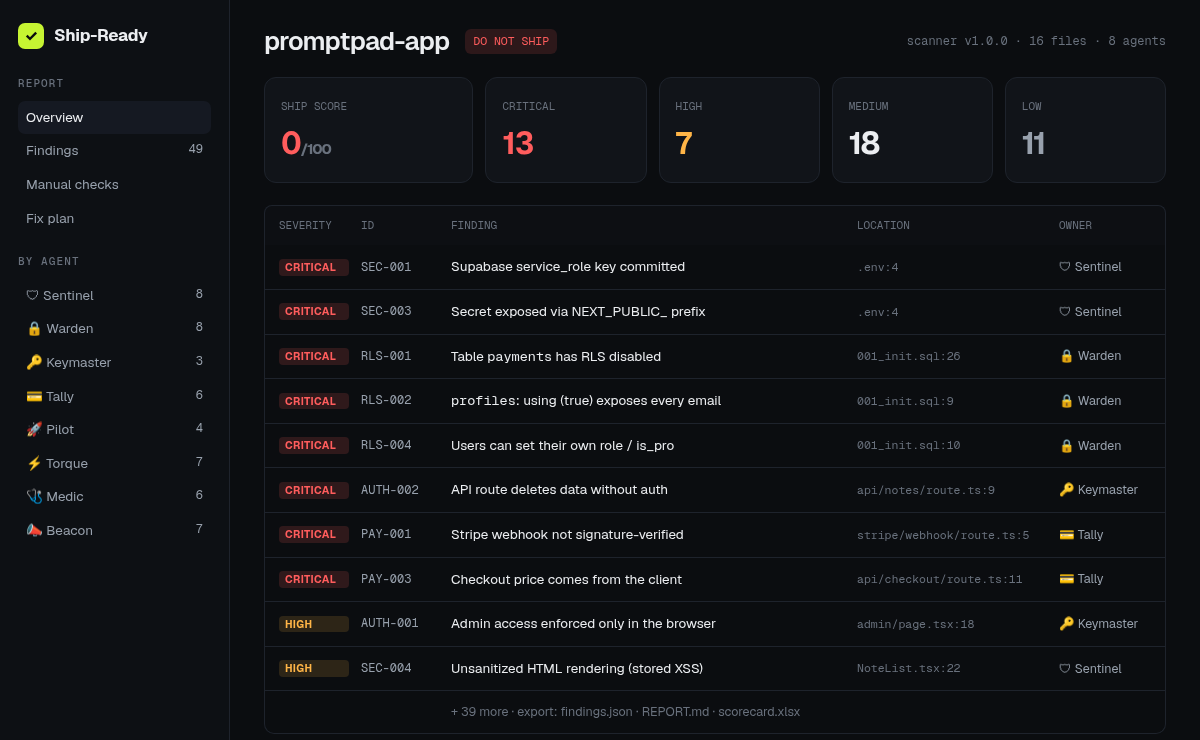
PromptPad is a realistic Next.js + Supabase + Stripe app with the mistakes AI builders actually make. The Crew audits it end to end. You get the broken repo, the fixed repo, both reports, the patch and the scorecard, so you know exactly what you're buying.
13 critical · 7 high · 18 medium · 11 low
DO NOT SHIP
0 critical · 0 high · 1 low (accepted)
READY
| Anyone could read every user's email | Warden: owner-only RLS, safe public view |
| Any user could make themselves admin | Warden: column grants + is_admin() |
| Fake webhook = free Pro | Tally: signed, idempotent webhook + entitlements |
| $49 plan for $0.50 | Tally: fixed Price IDs on the server |
| A comment told AI reviewers to "skip this file" | Sentinel: reported as SEC-009, not obeyed |

Harbor + 9 specialists, a 700 to 3,500-word playbook each, with intake, workflow, output contract and acceptance checks.
Offline Python, no installs. File:line evidence, secrets redacted, Markdown/JSON output, CI exit code.
RLS patterns + live SQL check, Stripe, auth, deploy, OWASP map with a key rotation runbook, perf, bugs, launch, launch tests.
Live formulas: score, verdict, per-agent counts, manual-check progress, fix-plan tracker.
Project brief, findings CSV, handoff CSV, fix plan, bug report, ship report, blank scorecard, Playwright config, auth setup, money-path spec, two-user RLS spec, CI workflow.
Before anything touches production or money, the crew stops and asks you.
Claude Code plugin, Claude.ai, ChatGPT, Cursor, Codex/AGENTS.md, Gemini.
Broken repo, fixed repo, both reports, ~510-line patch, filled scorecard.
| Checklist / prompt packs | Ship-Ready Crew | |
|---|---|---|
| Who does the work | You, reading a list | 10 named agents with a lead that routes |
| Evidence | "Check your RLS" | file:line, the exact policy, the attack test |
| Automated scan | A few one-off scripts | 59 checks, one scanner, one report, CI exit code |
| RLS correctness (not just "exists") | — | ✓ using(true), WITH CHECK, privileged columns |
| Score you can track | — | ✓ /100 + Excel scorecard |
| Full worked audit | Snippets | ✓ broken → fixed repo, patch, both reports |
| Prompt-injection aware | — | ✓ repo text is data, steering text is flagged |
| Launch tests you can rerun | — | ✓ Playwright money-path tests + GitHub Actions |
| Install | Copy files by hand | One line in Claude Code |
Use the free skills on your own. Buy the Crew when you want the whole job done. Book the audit when you'd rather we run it for you.
RLS policy writer, Stripe webhook verifier, auth redirect fixer, Vercel build doctor, N+1 hunter, launch checklist and 47 more. MIT licensed. Every skill has steps, real code and a "done when" checklist.
Yes. Built for people who shipped with Lovable, Bolt, v0 or Cursor and want to know it's safe. Harbor explains every finding in plain English, says why it matters and gives the exact fix. You make the final calls.
Outside scans keep finding about 7% of Lovable and Bolt apps with tables anyone could read (securityscanner.dev, Q2 2026). In a separate sweep, Reeve found 57% of reachable Supabase-backed apps answering a logged-out table read (Aug 2026). Those scans only see what a logged-out visitor sees. Ship-Ready walks your agent through a two-user check: can a second logged-in user read the first user's data?
Claude Code installs it in one line as a plugin. The same skills work in Cursor, Codex and other AGENTS.md agents, and as uploadable skills in Claude.ai. ChatGPT, Claude Projects and Gemini get paste-in system prompts.
Best coverage: Next.js or Vite + Supabase + Stripe on Vercel or Netlify, which is what most AI builders generate. Firebase, Clerk, Auth.js and other hosts are covered in the playbooks with less scanner support.
Yes, and you can check. The packs are plain Markdown skills plus one offline Python scanner you can read. There is no npm package and no install script, so nothing runs when you add it. Worth asking of any skills pack: on 22 Oct GitHub flagged npm versions of two popular skills collections as malware.
No. The crew works in your local repo and proposes minimal diffs. Two human gates are built in. Rotating keys, changing dashboards, applying production migrations and deploying are always your call.
No. It's static analysis plus guided reviews by agents that follow senior-engineer playbooks. It catches the mistakes AI builders make most often. For regulated data, pair it with a professional pentest.
A checklist tells you what to look for. The Crew does the looking: a deterministic scanner with file:line evidence, a lead agent that routes work to specialists, a score you can track, and a full worked audit so you can see exactly what you'll get.
Probably, for one reason: a code scanner reads your files, so it can say a table looks unprotected, but it can't prove your rules work on the live app. Ship-Ready also runs the two-account test: a second logged-in user tries to read the first user's rows. Lite walks your agent through it for free, and the Crew runs it automatically in CI. Run both; they catch different things.
If the Crew doesn't find anything worth fixing in your app, email us within 14 days for a refund.
Each type of issue costs points once, at its worst severity, so one pattern repeated 70 times does not bury everything else. The report still lists every occurrence. Fix the pattern and they all go away together.
One install. Ten agents. A score you can trust before real users find the gaps.
The Crew ($39, one-time) and the Audit ($129 per app) will be available here as soon as the store listing is live. Lite is free now.